
What Size Heat Pump Do I Need in Perth?
Figuring out what Heat Pump you need can seem quite complicated at first, but this guide is designed to get you started. Every pool is different and there are many contributing factors to consider but this information should get you on your way!
The very first thing to consider is does your pool have a pool cover / solar blanket? If it doesn’t keeping your pool at temperature becomes significantly harder and this is the single biggest contributor in requiring a much more powerful unit! Perth has cooler nights than most other cities in Australia so without a cover you will be starting from a much lower temperature the next morning, with a cover most of this heat is going to stay in your pool and the Heat Pump will have a far easier task to hit your set temperature the next day.
What volume is my pool? If you don’t know how many litres of water is in your pool it’s best to do a rough calculation and find out now as it’s gunna help you with pretty much everything you need as a pool owner down the track, especially chemicals. You need to know the pool volume to calculate your heating requirements.
Next is asking yourself when do I want to use my heated pool? Heating in summer in Perth is not that hard, there’s plenty of hot weather to go around, coming into shoulder seasons Autumn and Spring we notice a drop off in average temperature this is when your heat pump really comes into play, you can extend your swim season for those nice weekends during March and April or October and November. If you have your sights set on year round swimming through June, July, August and September then you will need to upsize your Kw accordingly. The air is cool, days are short and temperatures can stay low for longer periods, this is when your Heat Pump will be working hard trying to heat your water.
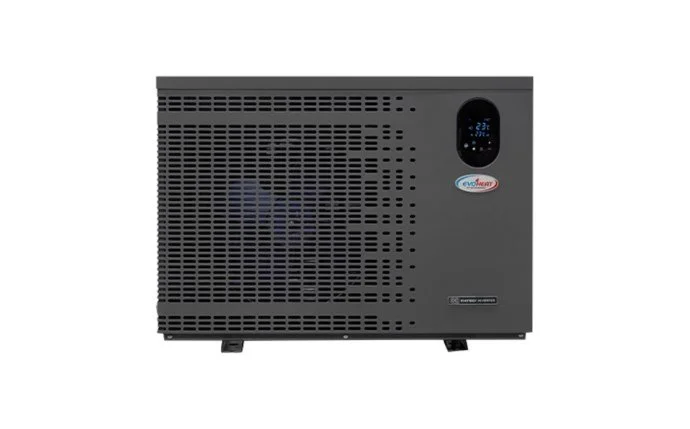
The following chart is always given as a general estimate based on a manufacturer aggregate to get you started, there is always lots of other smaller mitigating factors that can vary performance, Heat Pump models can differ on efficiency, pool features such as infinity walls or large shade coverings will chip away but all these factors can usually be considered afterwards before your final decision rather than complicating things further at this stage.
I’ve found the size what now?
Now that you have a Kw size, you can think about the next two important considerations, power supply and positioning.
Power Supply
Heat Pumps vary in the amount of amps they require to run. The smallest units can just be plugged into a standard 10A GPO, units up to around 14kw can usually be run from a dedicated 15A GPO, as you start to advance past that they will need their own hard wired electrical supply back to the main board usually with a double pole isolator controlling a 20A to 60A source.
This is an important thing to consider as every property is different, how easy and far is it to get that power to the pool equipment. Usually it is good to communicate with an electrician at this point to see how much work is going to be required to install power to the Heat Pump.
Positioning
Positioning is also something that can often be an after thought, Heat Pumps need air flow, if you are wanting the heater to be inside a pump room, shed or garage then it is going to need suitably venting to the outside, if you have a tight space down the side of a fence or in a corner of the block or behind a garage then the heater may not have enough clearance space, this is where you can consider side vented or top fan models to solve this problem, however these can be more expensive, you may also need to upsize the Kw to compensate for lack of air flow. See our guide for some Do’s and Don’ts, don’t spend hard earned money on heating only to stifle it’s performance on the day of install. Give the heater all the help it needs with some good open air flow and you’re gunna see greater performance.
Exact dimensions of specific models can be found on most manufacturer websites.
Pool Advice Centre
-
Adding heating to your pool is often easier than you may think, but there are of course some important things to consider. We have created a guide to help you get started!
-
Not every Pool Technician understands Chemigem systems but we definitely do and have been repairing them for over a decade!
-
-
-
There are several reasons a pool turns green but the most common is a lack of sanitiser usually from a failed salt cell or failed liquid feeding. Check if your cell needs a clean or that your feed lines aren’t blocked.
If it’s nothing simple get in touch and we will see what’s going on
-
Pool Owners guide to pool installation
-
Usually a filtration issue but can also be a pump issue. We can deep clean existing filters or offer replacement elements
-
Some pools have an overflow plug to waste out excess. Some pools may have been plumbed in a way that allows for you to drain out excess rain water via a waste valve. Many pools however have no obvious way for you to lower the water level. We can do a site review for you and explore the options available at your property so you can manage this issue going forward.